The question
What changes when a rocket gets lighter as it climbs? What happens if you remove drag? I wanted a way to turn my interest in aerospace into experiments I could run and inspect.
What it does
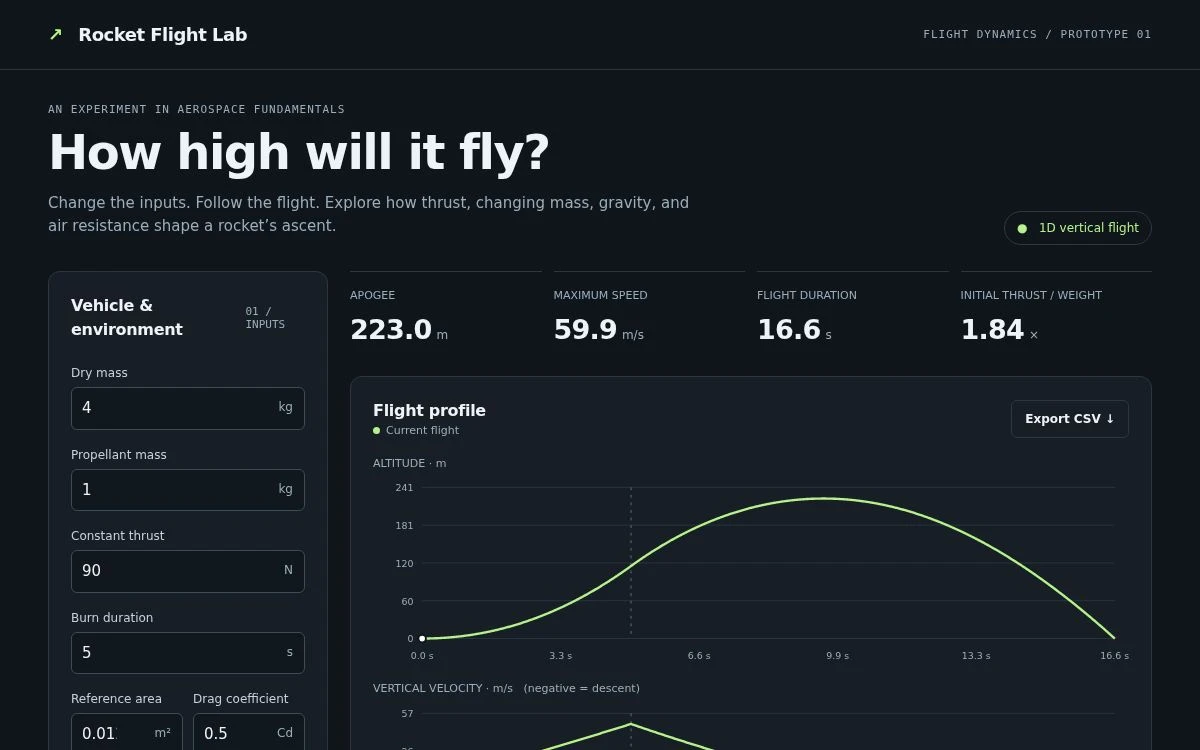
Rocket Flight Lab models one stage moving vertically. Change the mass, thrust, burn time, area, or drag coefficient; then inspect the altitude and velocity curves, play back a flight, pin a comparison, or export the time series as CSV.
My contribution
I chose the project direction and sought feedback on aerospace research ideas. Codex generated the initial interface, physics implementation, and tests. I treat this as an AI-assisted starting point for learning and further investigation, with the assistance documented in the repository.
From equations to something testable
The model uses fourth-order Runge–Kutta integration with a 0.02-second default step. It accounts for changing propellant mass, constant thrust during the burn, gravity, and an exponential atmosphere. Six numerical checks compare analytical no-drag cases, time-step convergence, pad behavior, and burnout mass.
Where it stands
The default simulated flight reaches approximately 223 metres with drag. That is a model output, not a measured flight result. The current model does not include wind, attitude, staging, parachutes, or orbital motion.
What comes next
I want to document controlled experiments, understand the effect of the model’s assumptions, and work toward comparison with openly documented flight measurements before attempting broader trajectory optimization.